What Is Consol — When a 300-Year-Old Bond Meets Blockchain
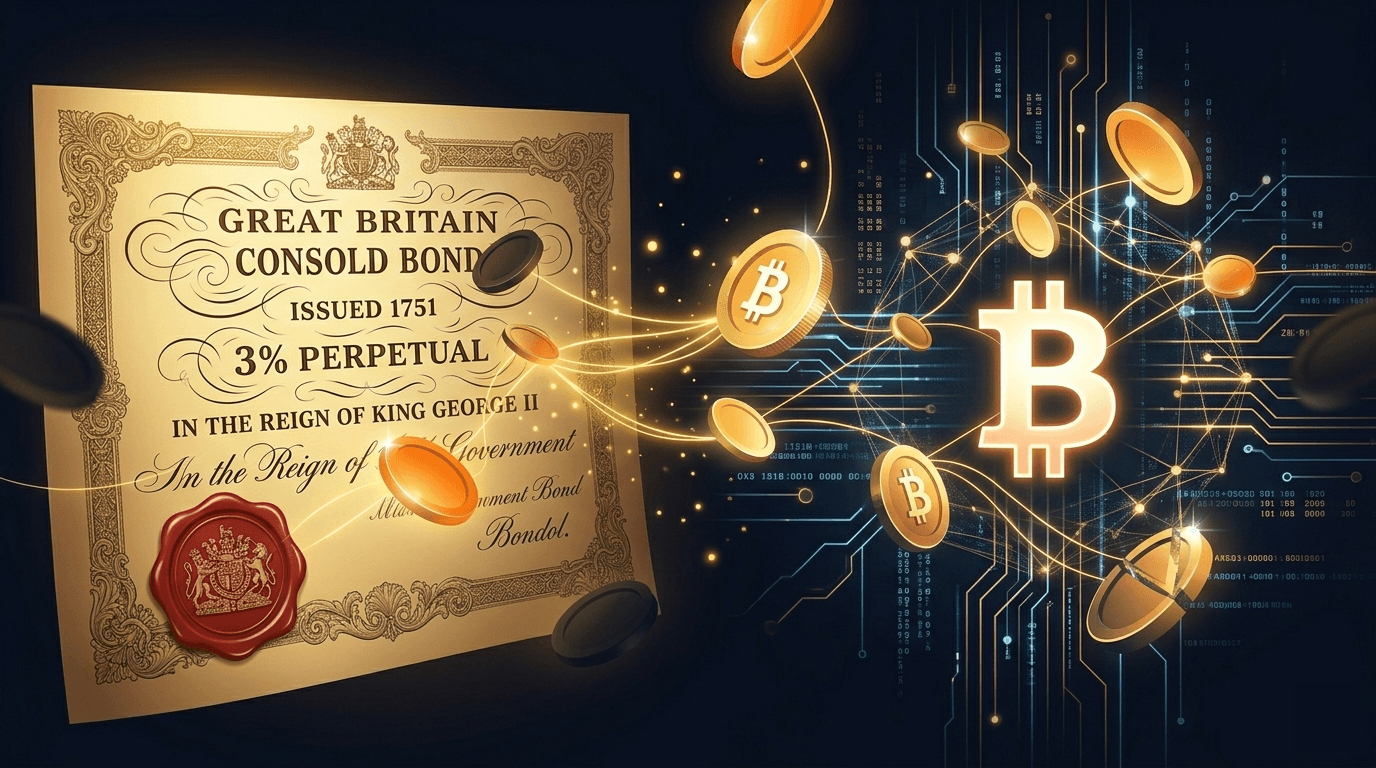
In 1751, the British government issued a bond with no maturity date. It paid interest for 264 years. That same structure is now running on the BTCMobick network.
Lee Chang Jun
Insights
What Is Consol — When a 300-Year-Old Bond Meets Blockchain
A Bond With No Maturity
In 1751, the British government issued a peculiar bond. It had no maturity date. No principal repayment schedule. Instead, it paid interest to holders in perpetuity. It was called Consols — short for Consolidated Annuities. One of the longest-surviving financial instruments in history.
Consols were simple. Buy, hold, collect interest. No principal to reclaim, no maturity to track. For investors, it meant a stable cash flow. For the issuer, it meant funding without repayment pressure. The British government used this structure to finance everything from the Napoleonic Wars to World War I. Consols continued paying interest until 2015 — 264 years.
In finance textbooks, Consols are treated as the prototype of the perpetual bond. The structure lives on in modern finance: perpetual subordinated bank debt, preferred stock dividends — all variations of the same idea.
Why Crypto Never Had This Structure
The most common way to earn yield in blockchain is staking — depositing assets into a network and sharing in validation rewards. It works, but it carries structural problems.
First, loss of custody. Most staking requires entrusting assets to a third party — an exchange, a validator operator, or a staking pool. The moment your private key leaves your hands, calling it "your asset" is only half true. As FTX demonstrated, custodied assets are exposed to the custodian's credit risk.
Second, lock-up rigidity. Unbonding periods prevent asset withdrawal for a set duration. Markets can move violently while your assets remain frozen.
Third, inflationary dilution. Staking rewards are mostly funded by new token issuance. When everyone stakes, the reward rate holds but the token's value dilutes. What remains is nominal yield, not real yield.
How BTCMobick Consol Is Designed
BTCMobick's Consol sidesteps these problems.
The core principle is self-custody. Users don't send their assets anywhere. They don't surrender their private keys. BTCMobick stays in your wallet, and the act of holding itself becomes the condition for receiving interest. Third-party risk is eliminated at the root.
The British Consol's logic — "buy, hold, collect interest" — is replicated on a blockchain. The difference is that instead of government credit, protocol rules guarantee the payout.
This structure naturally incentivizes long-term holding. Since holding itself generates yield, the incentive to sell short-term diminishes. This contributes to market stability, and a stable market in turn makes long-term holding more attractive. A virtuous cycle.
How It Differs From Staking
Conventional staking requires custodying assets with a third party, sharing or surrendering private keys, enduring lock-up periods, and accepting counterparty risk. Its core mechanism is network validation rewards.
BTCMobick Consol keeps assets in your own wallet, never requires key surrender, imposes no lock-up period, and carries no third-party risk. Its core mechanism is the perpetual bond interest model.
The Old Becomes New
It is no coincidence that the longest-running structure in financial history was also the simplest. Consols operated for 264 years. While complex derivatives collapsed in 2008, the logic of the simple perpetual bond remained sound.
BTCMobick Consol transplants this proven financial logic into a decentralized environment. It strips away the complexity and risk of staking, and implements the most fundamental investment logic — "hold and earn" — on a blockchain.
The principle that worked in the City of London 300 years ago is working again on the BTCMobick network today.