The GENIUS Act — The New Line America Has Drawn for Stablecoins
In 2025, the United States finally defined stablecoins by law. The GENIUS Act marks America's first official answer on which models will survive and which will no longer be allowed.
Lee Chang Jun
Insights
When the Terra ecosystem collapsed in May 2022 and the $18 billion UST became worthless within a matter of days, the impact extended far beyond a single market event. An estimated 280,000 investors in Korea alone suffered losses, and serious regulatory discussions began in the U.S. Congress. Three years later, in 2025, the United States finally defined stablecoins by law. The result is known as the GENIUS Act, formally the Guiding and Establishing National Innovation for U.S. Stablecoins Act.
Given that stablecoins have already grown to a $200 billion market and effectively function as the reserve currency of the crypto economy, the significance of this legislation goes well beyond ordinary regulation. It represents America's first official statement on which forms of stablecoin will be permitted to survive and which will no longer be allowed.
What the GENIUS Act Requires
The GENIUS Act imposes five core obligations on payment stablecoins.
The first is full 1:1 backing. Every token issued must be backed by reserves equivalent to one U.S. dollar, and those reserves must be held in safe, readily redeemable forms such as cash or short-term U.S. Treasuries. Reserves cannot be held in risky assets or in other crypto assets.
The second is monthly third-party audits. Issuers are required to have an independent accounting firm verify their reserves every month, and the results must be made public. Requiring monthly rather than quarterly or annual verification is one of the features that distinguishes this law from earlier regulatory proposals.
The third is restricted issuer qualifications. Only federally or state-chartered financial institutions, or businesses meeting equivalent standards, are permitted to issue stablecoins under the act. The era in which anyone could mint tokens has effectively come to an end.
The fourth is mandatory bankruptcy-remote custody. Even if the issuer goes bankrupt, user assets must be protected, and reserves must be held in trust structures separate from the issuer's own balance sheet.
Finally, AML/KYC protocols are explicitly required. Issuance without anti-money-laundering and identity-verification procedures is no longer permitted.
When Terra's Lesson Became Law
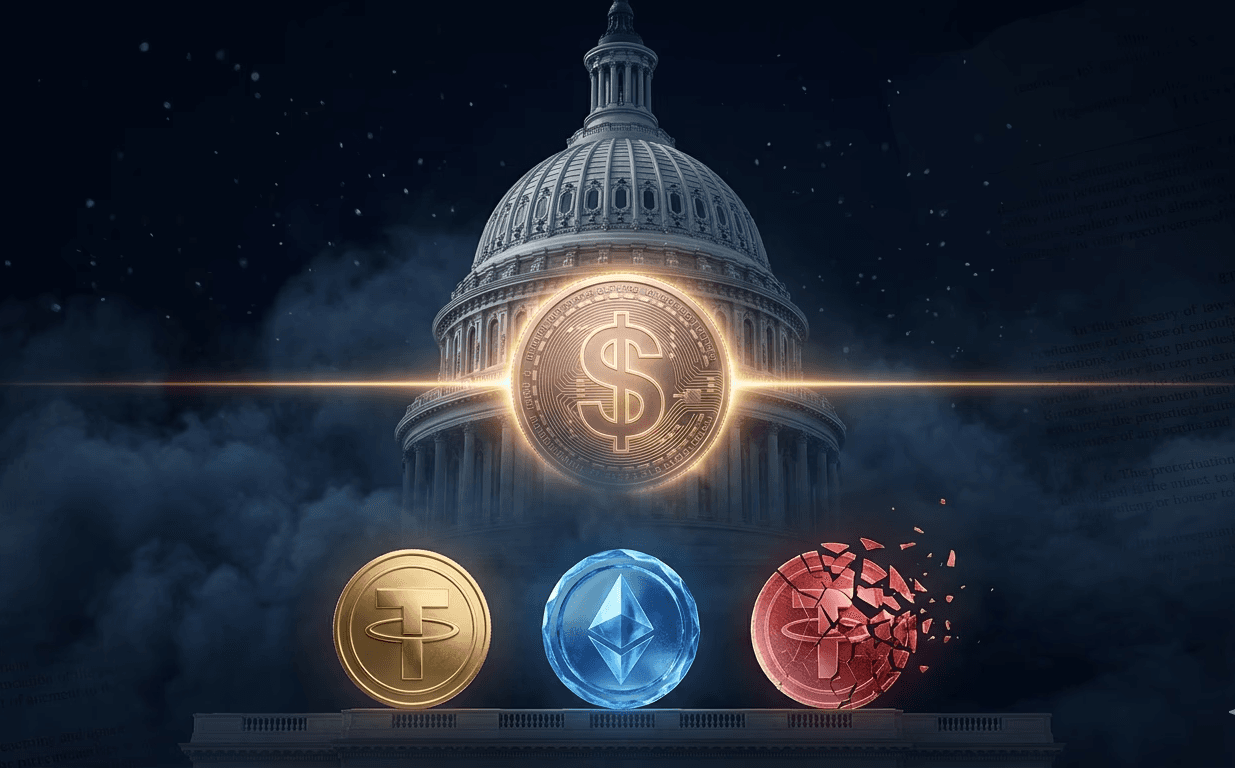
The most decisive change introduced by the GENIUS Act is that it effectively prohibits the issuance of algorithmic stablecoins. With full 1:1 backing now a legal requirement, models that maintain their peg solely through algorithms and incentives, without holding any collateral, can no longer qualify as legitimate payment stablecoins.
In effect, the lesson of the Terra/UST collapse has been written into law. The algorithmic model, which once promised 100% capital efficiency and unlimited scalability, caused too much damage to the broader market when those promises failed. The United States has decided not to allow the same kind of damage to occur again.
What This Means for USDT
The GENIUS Act also sets out separate conditions for stablecoins issued outside the United States. Foreign issuers seeking access to the U.S. market must complete a U.S. registration process and meet a defined level of regulatory compliance. Free circulation is not granted simply because a stablecoin was issued abroad.
This has direct implications for Tether (USDT), whose parent company is based outside the United States. By contrast, USDC, which is issued in the U.S. and was designed from the outset to align with GENIUS Act standards, finds itself in a relatively favorable position. This dynamic points to the possibility of a significant reshaping of leadership in the global stablecoin market.
The Market Is Already Moving
Several distinct trends have emerged since the passage of the GENIUS Act.
The most visible is the acceleration of institutional adoption. With a clear regulatory framework now in place, traditional financial institutions and large corporations that had previously hesitated due to legal uncertainty are beginning to seriously consider stablecoin adoption. Cases in which qualified custodians such as BitGo handle both the issuance and custody of GENIUS-compliant stablecoins are already appearing.
On the other side, barriers to entry have risen rapidly. Smaller stablecoin projects and issuers without the capacity to meet regulatory requirements are being squeezed out of the market, and as a result the industry is consolidating around a smaller number of large issuers.
In terms of overall market size, the likely outcome is accelerated growth. Regulatory clarity creates trust, and trust draws in capital. Some analyses suggest that the stablecoin market could expand to roughly $1 trillion within five years of the GENIUS Act's passage.
The Question That Remains
The GENIUS Act represents clear progress, but it also carries one significant limitation. The law is fundamentally designed around fiat-backed stablecoins, the 1:1 dollar-backed model represented by USDT and USDC. Models built on crypto collateral, such as DAI, or even newer forms of collateral structure, are still left with open questions about how they should evolve.
The United States has offered one answer, but it is not the only possible answer. In other regions, including Asia and Korea, different regulatory environments and different market needs may give rise to different forms of stablecoin. The BTCMobick ecosystem, building on its own mainnet asset, is also continuing work to explore what kind of answer is possible within this broader landscape. The specific design will be addressed in a separate post.
The most important takeaway from the GENIUS Act is that stablecoins are no longer purely internal to the crypto market. They have become part of the U.S. financial system and are taking their place as a component of global payment infrastructure. With the rules now changed, the next stage of evolution will play out on top of those rules, or in new territory that lies beyond them.